Tips for Writing Successful Grant Proposals in Education

Successful education grant proposals connect a clearly documented school need with a feasible project, responsible budget, and measurable results. For school administration teams, the strongest applications make it easy for reviewers to see why funding is needed, how the money will be used, and what will improve for students or the wider school community.
There is no universal formula for winning education grants. Each funding opportunity has its own eligibility rules, priorities, application format, and selection criteria. A disciplined process can still improve your school’s proposal by keeping every section aligned from the initial needs assessment through the final submission.
Start With the Funding Opportunity and Funder Priorities
Begin by studying the funding opportunity and funder priorities before writing the grant proposal. Confirm that your school is eligible, identify the funder’s goals, and create a checklist of every required response and attachment.
Read the complete guidance, including application instructions, allowable-cost rules, geographic restrictions, award size, deadlines, and reporting expectations. A compelling project can be rejected if the applicant is ineligible, the request exceeds the funding limit, or a required document is missing.
Build an alignment checklist
- Eligibility: Verify that the school, district, nonprofit partner, or other applicant meets the stated requirements.
- Purpose: Identify the educational challenge or population the funder intends to support.
- Selection criteria: Note how reviewers will judge need, project quality, capacity, evaluation, and budget.
- Compliance: Record formatting rules, page limits, matching-fund requirements, signatures, and attachments.
Then map the proposed project to the funder’s language without forcing a connection. If a grant supports literacy intervention, describe the school’s reading initiative in terms of relevant student outcomes, instructional methods, and implementation capacity. Choosing a closely aligned opportunity may reduce the number of grants your team pursues, but it usually produces a more credible application than adapting one project to every available fund.
Authoritative federal opportunities and program guidance can often be checked through Grants.gov. Treat the published notice and official instructions as the controlling source rather than relying on summaries or outdated application templates.
Define a Clear School Need
A strong needs statement uses current school data and stakeholder input to explain a specific, consequential problem. It should show who is affected, how the need appears in practice, and why existing resources are insufficient.
Start with a focused needs assessment. Relevant evidence might include attendance patterns, course completion, reading or mathematics performance, behavior referrals, enrollment information, student surveys, teacher observations, family feedback, or program participation records. Use data that directly relates to the proposed project instead of filling the section with every negative trend the school has identified.
Move from symptoms to causes
A weak statement says, Students need better technology. A stronger version explains that teachers lack reliable devices for a particular instructional activity, identifies which learners are affected, and connects the gap to a documented instructional outcome. The second version gives the funder a problem that can be addressed and evaluated.
Ask three questions:
- What is happening, and how do we know?
- Who experiences the impact most directly?
- Why is the proposed intervention an appropriate response?
Include stakeholder perspectives from teachers, students, families, counselors, finance staff, and community partners when relevant. Their input can reveal implementation barriers that administrative data misses. Protect privacy by reporting aggregated information and following applicable school data policies. A persuasive needs assessment does not exaggerate hardship; it establishes a defensible connection between evidence, project design, and student or institutional needs.
Develop Specific Goals, Objectives, and Activities
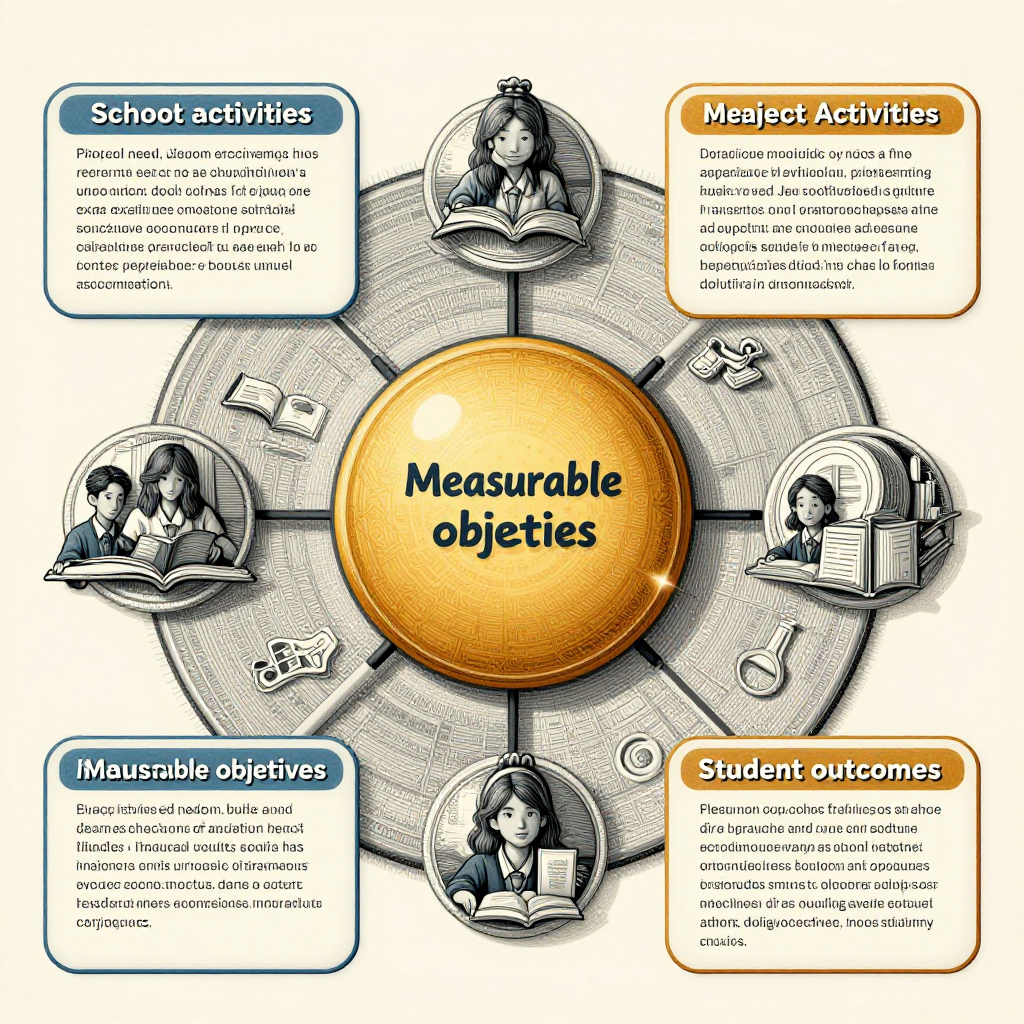
Effective grant proposals connect broad goals to measurable objectives, practical activities, responsible staff, and intended outcomes. Reviewers should be able to follow the project logic from the identified need to the change the school expects to create.
A goal states the larger direction, such as improving ninth-grade mathematics readiness. An objective makes that goal testable by identifying the population, change, measurement method, and timeframe. For example, a school might aim to increase the proportion of participating ninth-grade students meeting a defined benchmark by the end of the academic year, using a specified assessment.
Use an objective-to-activity test
For every objective, list the activities that will influence it. Activities could include professional learning, tutoring, curriculum materials, family workshops, mentoring, attendance outreach, or structured data meetings. Name the staff responsible for each activity and state when it will occur.
- Objective: What measurable change should occur?
- Activity: What will the school do to support that change?
- Owner: Which staff member or partner is accountable?
- Evidence: What records will demonstrate implementation and progress?
Watch for objectives that depend on factors the project cannot control. A school can measure participation in tutoring and changes in assessment performance; it should be cautious about promising that one short-term activity will eliminate a complex achievement gap. Specificity strengthens credibility, while unrealistic certainty weakens it.
Create a Realistic Grant Budget and Timeline
A realistic grant budget assigns a clear purpose to every cost and matches spending to the project activities and timeline. Reviewers should not have to guess why an item is necessary, how its amount was calculated, or when the school will use it.
Develop the budget with finance staff, project leaders, and relevant school administrators. List personnel time, supplies, equipment, contracted services, professional development, travel, communications, and indirect costs only when the funding opportunity permits them. Explain quantities and unit costs where useful. For example, connect the number of training sessions to the number of participating staff, or connect materials to the number of classrooms and students served.
Check budget alignment
- Every significant expense supports at least one stated activity.
- Every major activity has the resources needed to operate.
- The budget follows the funder’s allowable-cost and cost-sharing rules.
- Existing school resources and in-kind contributions are identified accurately.
- The requested amount reflects a feasible scope rather than an inflated wish list.
Create a timeline with preparation, launch, implementation, monitoring, adjustment, and closeout stages. Include procurement lead times, staff training, student recruitment, family communication, data collection, and reporting deadlines. A project that begins immediately after an award may still require several weeks for purchasing and scheduling.
Choosing a larger project for broader reach means accepting greater staffing, coordination, and reporting demands. If the budget cannot support high-quality implementation, reduce the scope and explain how the selected scale will produce meaningful results.
Build a Strong Evaluation and Sustainability Plan
An evaluation plan explains how the school will track implementation, measure outcomes, and use findings to improve the project. A sustainability plan explains how useful activities or benefits can continue after grant funding ends.
Start with a small set of indicators tied directly to the objectives. Process indicators show whether the project was delivered, such as attendance at workshops, number of tutoring sessions, staff training completion, or materials distributed. Outcome indicators show what changed, such as assessment results, course completion, attendance, student engagement, or teacher practice.
Make evaluation practical
For each indicator, identify the data source, collection schedule, responsible person, and method of review. A simple evaluation table in the proposal can clarify the design:
- Indicator: Percentage of participating students completing the intervention.
- Source: Program attendance and student records.
- Timing: Reviewed monthly and summarized at project close.
- Use: Adjust outreach or scheduling if participation falls below the project target.
Do not promise to prove more than the design can show. A school-funded project may document improvement among participants without claiming that it caused every change in schoolwide performance. Transparent limitations make the evaluation more trustworthy.
Sustainability can involve incorporating effective practices into the school improvement plan, training internal staff, using reusable curriculum resources, reallocating existing funds, developing a community partnership, or seeking a different funding source. Avoid presenting future grants as the only continuation strategy. Explain which costs will remain, who will own the work, and what the school can realistically maintain.
Strengthen, Review, and Submit the Proposal
Before submission, review the complete grant proposal for alignment, compliance, clarity, and completeness. A final review should test the application as a funder would, not simply correct spelling.
Ask an internal reviewer who did not write the draft to summarize the project after reading it. If that person cannot identify the need, activities, budget logic, expected outcomes, and sustainability approach, revise the proposal. The school administration team should also confirm that teachers, finance staff, leadership, and partners agree on responsibilities and commitments.
Final submission checklist
- Eligibility and funder priorities have been verified.
- The needs assessment uses relevant, current, responsibly presented data.
- Goals, objectives, activities, staffing, and outcomes are consistent.
- The grant budget matches the narrative and follows allowable-cost rules.
- The timeline includes realistic preparation and reporting milestones.
- The evaluation plan identifies indicators, data sources, and responsible staff.
- The sustainability plan addresses post-grant ownership and resources.
- Required signatures, letters, quotes, forms, and attachments are included.
- Page limits, file formats, naming rules, and submission instructions are satisfied.
- The application is submitted before the deadline, with confirmation retained.
Common errors are usually preventable: copying a generic narrative, using vague objectives, hiding costs in broad categories, or submitting without checking attachments. Persuasive language may improve readability, but evidence, planning, and compliance carry the proposal. Give the final review enough time to correct inconsistencies rather than treating it as a last-minute proofreading exercise.
Frequently Asked Questions
What are the most important sections of an education grant proposal?
The most important sections usually explain the school need, project goals and objectives, activities, staffing, grant budget, timeline, evaluation plan, and sustainability plan. Their strength depends on alignment: the need should justify the project, the activities should support the objectives, and the budget should pay for the activities described.
How can schools demonstrate a genuine need for funding?
Schools can demonstrate need through relevant student and school data, stakeholder input, documented resource gaps, and a clear explanation of why existing resources cannot address the problem fully. Use specific evidence connected to the proposed project and avoid unsupported claims or exaggerated language.
How detailed should a grant proposal budget be?
A grant budget should be detailed enough for reviewers to understand each major cost, its calculation, and its connection to project activities. Follow the funder’s required categories, explain unusual expenses, identify in-kind resources accurately, and avoid requesting costs that the project cannot reasonably use.
What makes grant objectives measurable?
Measurable objectives identify who will experience a change, what change is expected, how it will be measured, and when it should occur. An objective should rely on a defined data source and a realistic target rather than words such as improve or increase awareness without a measurement method.
How can a school show that a project will be sustainable?
A school can show sustainability by naming the people who will continue the work, identifying future resources, embedding effective practices into regular school operations, and explaining how materials or training will remain useful. A credible plan acknowledges ongoing costs and avoids assuming that future grant awards are guaranteed.